

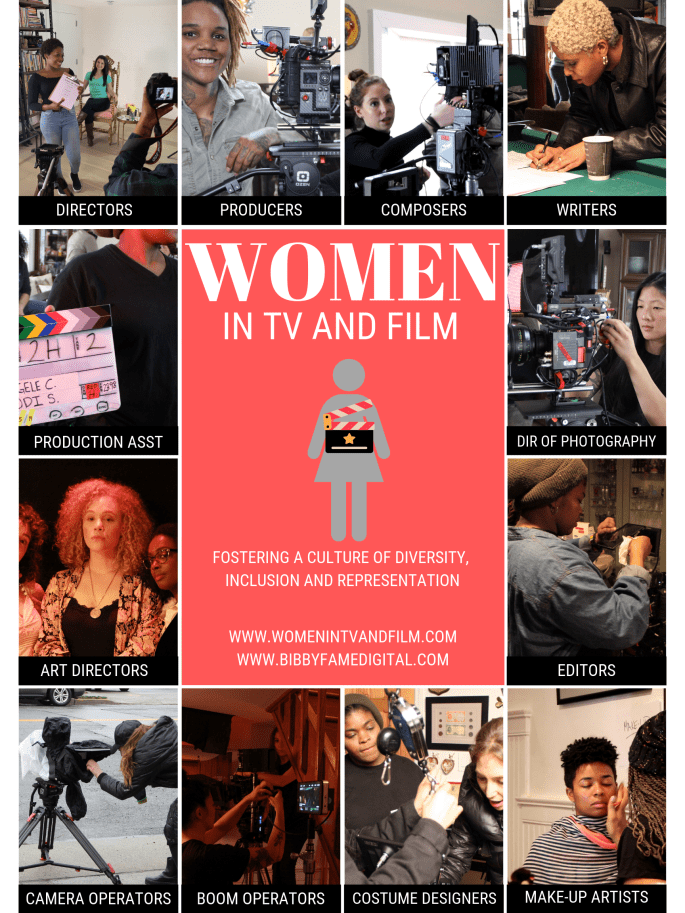
This is a very important question. One that doesn’t have a straightforward answer. It’s easy to slap together statistics to paint the dire picture of what is transpiring with women in the television and film industries. However, generating a solution or corrective action plan isn’t quite so simple. With the creation of Women in TV and Film, I was extremely cautious not to make this a finger-pointing, blame-game or pity-party because no one is rolling out the red carpet for us to access the boys club. I wanted to highlight positive attributes and micro-level methods to evoke change that both you and I can implement NOW. In the introductory stages of conceptualizing the project, I asked myself two fundamental questions:
- What can I do to help?
- How can I build awareness and change perception?
I don’t have money. My career is still in infancy stages. I don’t have the power to create macro-level change.
Do I delve into why things are the way they are, or do I paint a picture that visualizes HOW IT COULD BE? I chose the latter.
My approach with this project was to:
- Actively work in a filmmaker capacity
- Work alongside other women in TV and Film
- Showcase various women in TV and film through my social media and web platforms
- Document the innerworkings of film sets with exclusively female cast and crews
- Attend events, conferences and screenings that support female filmmakers
- Network and build relationships with experienced women actively working in the industry
- Develop a rolodex (contact list) of women that can fulfil various above and below-the-line roles for future usage, reference and recommendation
- Show the world WOMEN MAKE MOVIES and WE ARE BADASS
Now, it’s YOUR TURN.
Companies: You should HIRE female filmmakers.
Filmmakers: You should recommend female filmmakers and take steps to ensure you have an inclusive work environment.
Consumers: You should support, watch and buy diverse and inclusive projects.
We can talk about corporate big-wigs but the reality of the matter is CONSUMERS HOLD THE POWER. When you buy food, you read the label. Similarly, when watching shows and films … you should research the credits. You should know about the content you are consuming. Female filmmakers know about the problems that exist, however, a large chunk of the TV-watching and movie-going population are completely oblivious. The program you love:
- Did a woman write it?
- Did a woman direct it?
- Did a woman edit it?
- Did a woman shoot it?
- How many women were involved in the production?
The population is 50/50 and women represent roughly half of movie-goers but we have less screen-time and less control of the narrative. YOU have the power to decide and evoke change.









 The media kit is a package of information that allows a company to present itself as it would like to be seen. The public relations professional uses the media kit to make it easy for the media to use supplied stories about their clients. Press kits can be found online in a company’s media room, however, for live events, the media kit can be supplied as a printed package. There are several components included in the media kit. In this discussion post, I will highlight six items commonly found in a media kit – the press release, backgrounder, fact sheet, key contacts, social media links and audio / video. Some other items that can be included are Q&A, biography and position paper.


 BibbyFame Digital, LLC: Photo, Film & Interactive Media